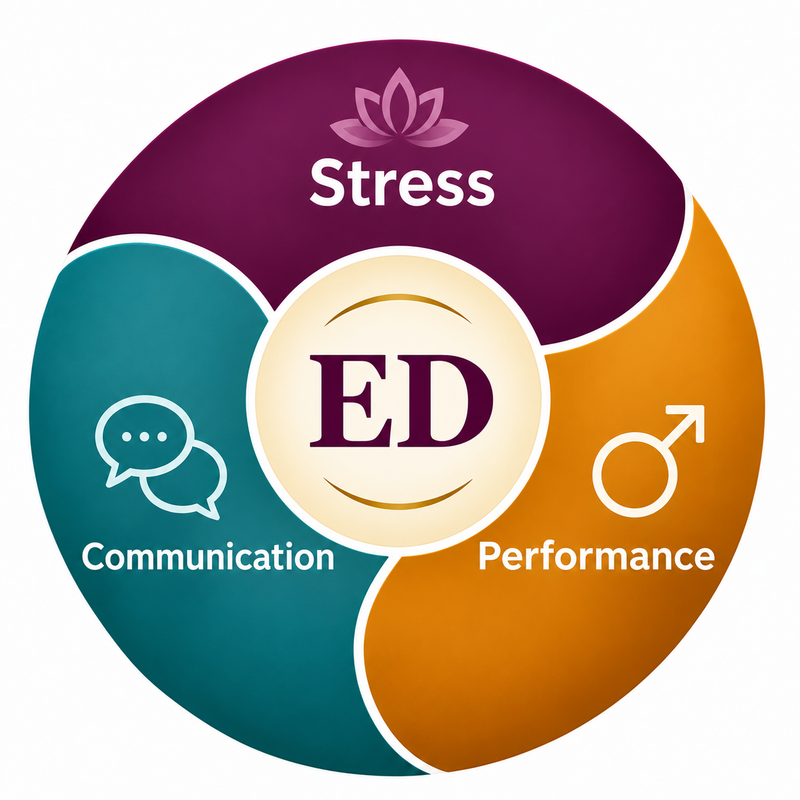
Erectile dysfunction is rarely just about one body part. In my work with men and couples around the world as a sex coach, it is, without a doubt, the number one reason men come to me. And in every single case, there has been some discomfort around communicating: about their anatomy, about how it functions, and about how they feel in their own bodies.
The first step is always to see your doctor, because ED can be a sign of an underlying medical condition.
Alongside that, there is a holistic approach. It rests on the idea that three main factors contribute to erectile dysfunction:
- Lack of Supportive Communication
- Stress
- Performance Rumination
Let's go through each one, with a simple practice you can start with today.
1. Communication: Learning the Language of Your Body
The cornerstone of communication is
interoception: the ability to report what is going on inside your body, most importantly to yourself, and then to your partner.
Most high-achieving men I've worked with are developing this muscle. They can run a company or a global team, but when asked what is happening in their body right now, the words aren't there often. Without those words, talking about sexual functioning feels like talking about failure.
The Practice: Finding The Words
Look through the list of sensation words and see if you can identify one part of your body and match it to a sensation word. Practice this once a day to increase mastery of reporting the state of your body not only to yourself but to a partner. This is interoception. Interoception must be mastered to access pleasure outside of ED. Why? Because pleasure must first be experienced as a sensation before it can be recognized, cultivated, and communicated to have more of it. Without interoception sex can feel like a numbing agent or endless quest never being quite satiated. So here are some examples of sensation words you can use to begin describing parts of your body.
| Temperature | Pressure & Weight | Movement | Texture & Surface | Tension & Ease | Size & Space |
|---|
| Warm | Heavy | Tingling | Smooth | Tight | Expansive |
| Cool | Light | Buzzing | Rough | Loose | Contracted |
| Hot | Dense | Pulsing | Prickly | Clenched | Spacious |
| Cold | Pressing | Fluttering | Soft | Relaxed | Narrow |
| Flushed | Sinking | Throbbing | Sharp | Rigid | Open |
| Clammy | Grounded | Twitching | Dull | Knotted | Hollow |
| Chilly | Floating | Shaky | Numb | Soft | Full |
| Burning | Achy | Flowing | Itchy | Fluid | Empty |
People who struggle to name their emotions often also have difficulty sensing body signals in general, so a simple sensation word is an easier way in.
Why It Works
Words for sensation lead to words for emotion. Once you can name what is happening in your body, you can start asking, What am I feeling in this moment? and describe it.
That is the goal:
talking about your sexual functioning from a place of sensation and emotion, not performance and pressure. From here, I coach men through the next steps, so they can talk to themselves and their partner about anything happening in their body, without judgment.
2. Stress: Expressing What You've Been Holding Back
Stress is one of the first things to affect the genitals, and the research backs this up. Erections depend on the body's relaxed, "rest and digest" state. Stress switches on the fight-or-flight response, which pulls blood away from the penis. A 2026 study of 826 working men aged 22 to 40 found that men under high workplace stress had about 10 times the odds of erectile dysfunction compared with men under low stress. In that study, rising cortisol came first, followed by falling testosterone, and then erectile problems weeks later (Huang et al., 2026).
From a holistic perspective,
stress is repressed expression. The high-achieving men I work with often carry cultural, family, and gendered expectations, and the higher they climb, the more stress tends to come with it. Individual parts deserve to be expressed, not suppressed.
The medical field focuses on lowering your stress. The holistic, Tantra-based approach I use does something different: it increases your genuine expression in the places where you have been holding back. You might assume that place is sexual, but more often it starts with expressing yourself emotionally or doing something creative you have always wanted to do.
Sexual expression can come later, but I don't recommend jumping straight there to counterbalance your stress. In my many years doing tantric bodywork with men, I saw the same thing again and again. High-achieving men starving for touch: to be appreciated through touch, to simply be present in a moment and be witnessed. Embodiment and touch lowered their stress significantly, right in the moment. It's one of the reasons Tantric Massage is so effective.
The Practice: Breath, Sound, and Movement
This short practice draws on half of a box breath combined with the tantric microcosmic orbit breath. It is a game changer that everyone who works with me is introduced to. It's a cornerstone breath used later as a sexual mastery breath where some men experience complete ejaculation mastery, stamina mastery, and pleasure mastery. However 1st, it's a stress game changer.
- Breath. Start at the base of your pelvis and inhale slowly for a count of four, imagining the breath winding up and around your spine. Pause at the top. Exhale for a count of four, imagining the breath traveling back down your spine and landing softly in your genitals.
- Sound. Repeat the same breath. On the exhale, add a sound: an exaggerated sigh, a hum, or whatever wants to come out.
- Movement. Breathe in once more. On the exhale, add a small movement: a roll of the shoulders, a shift in the hips, or simply getting more comfortable.
In Tantra, breath, sound, and movement are the three building blocks of life force energy. Barbara Carrellas, founder of Urban Tantra, describes breath alone as building erotic energy, with movement and sound taking it deeper (Carrellas, 2017). Training your body to use all three naturally is a strong foundation for addressing sexual concerns, including ED and premature ejaculation.
3. Performance Rumination: Redefining What Sex Is
Performance rumination is the constant replaying of thoughts about your sexual performance, and it usually comes out as a feeling of inadequacy. In our society, if one part of your body doesn't show up the way it's "supposed to," when it's supposed to, it somehow translates into not being enough.
The remedy is to acknowledge the totality of who you are and everything you have to give sexually. That begins with redefining what sex is.
Expand Your Definition
Find at least three to five ways for you and your partner to experience pleasure that don't involve an erect penis or intercourse. Penetration can still be part of it, with fingers and other things, but the point is changing your definition of sex.
Here is a trick I share with men: borrow some plays from the lesbian playbook. Lesbians have plenty of sex, often with their fingers. I tell every man that he has ten penises on his hands. There is no reason for one body part to carry the burden of showing up at a specific time, in a specific place, in a specific way.
Tantric Practices to Explore
- Five-elements touch: a practice I teach men and couples to discover how you really like to be touched, and in which ways.
- Presencing practices, such as eye gazing and hand on heart, which let you connect sexually and centrally with a partner and honor the full sensuality of who you are.
Your Homework
This is where communication comes back in. Use the interoception skills from section 1 to talk with yourself, and then your partner, about trying something beyond what you usually do.
Then commit to at least one hour of sensuality, romance, and connection before you even think about intercourse. Give each other a chance to connect in a truly deeper, sensual way.
The men who really take this on find that erections come from the lack of expectation to have one. Sometimes an erection doesn't happen, and sex isn't compromised either way.
This also works for premature ejaculation. In the couples I've worked with, when partners keep going with the bonding practices through and after ejaculation, sex doesn't have to end.
Redefining sex gives you a break from performance rumination.
You Don't Have to Live in the Shadows of ED
These practices are just a sliver of what's possible. I am a sex coach specializing in somatics and a PhD student in sexology, and much of my training comes from Tantra. It's an honor. Hope this helps.
Sources
- Carrellas, B. (2017). Urban tantra: Sacred sex for the twenty-first century (2nd ed.). Ten Speed Press.
- Huang, W., et al. (2026). Dose–response relationship between workplace psychological stress accumulation index and erectile function in young men. International Journal of Clinical Practice. https://doi.org/10.1155/ijcp/7492091 (summary)